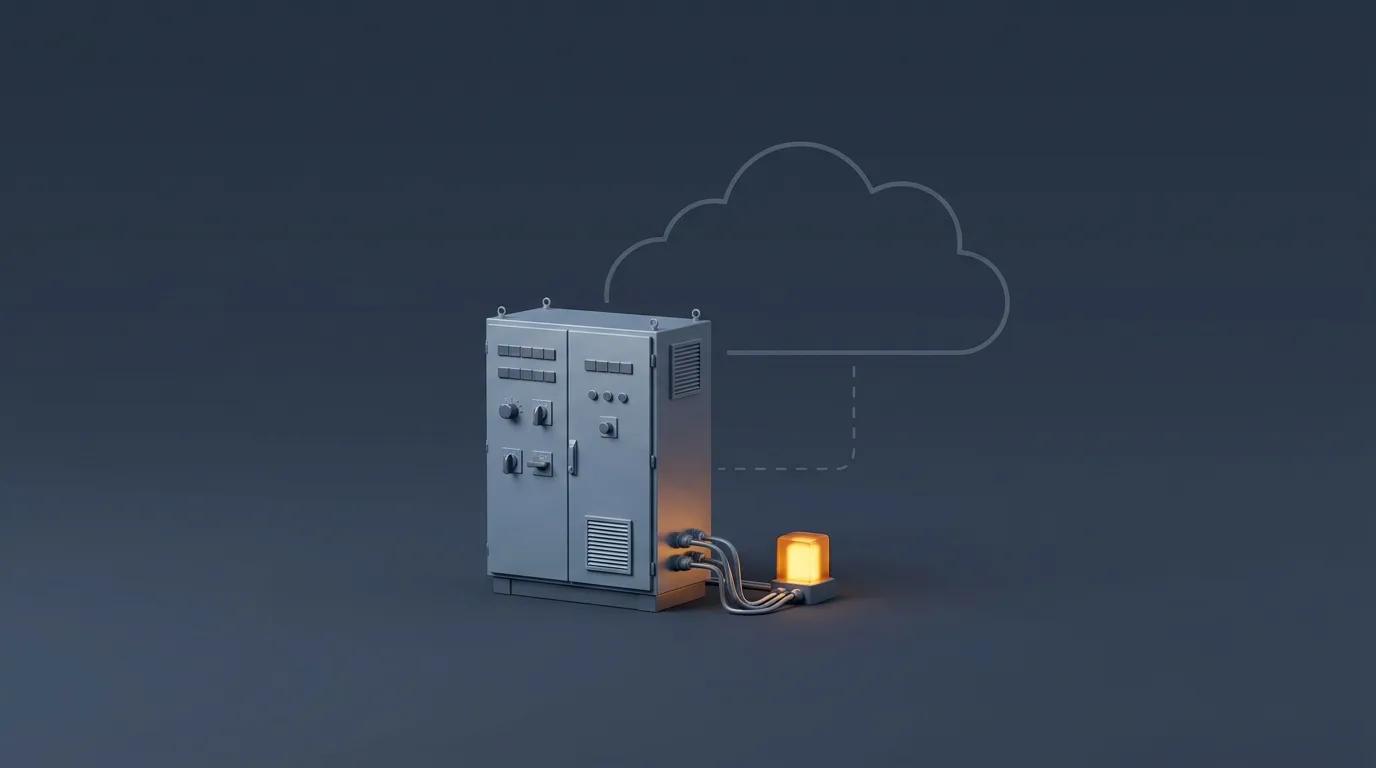
For the last two years I have worked on the MES of a large manufacturing group. The client wanted a cloud product, despite every sign pointing the other way, and bought one. We ended up building an on-premise middleware, much to my satisfaction. The middleware talks to the machines, keeps production running when the network is down and reconciles the data with the cloud. It also holds the custom business logic the product does not support.
All things considered, we built a MES from scratch next to the one that was bought. And the product's limits are still there.
I start here because it is what market forecasts do not tell you.
01How big the market is, and why the numbers don't add up
Five research firms, five numbers.
Global MES market according to five research firms
Billions of dollars; under each value, the expected annual growth
One estimate is three times the other because what gets counted changes: software only, or services and adjacent modules such as quality and maintenance too. Whoever quotes a single number has picked the definition that suits them. On one thing they all agree: the market is growing.
02Where MES runs
According to Mordor Intelligence, 62% of the market was on-premise in 2025. Deloitte's 2025 Smart Manufacturing Survey, covering 600 executives at US manufacturers, reports that 57% use the cloud.
The two figures fit together: the cloud is there, but the part that runs the line stays close to the line.
of the MES market is on-premise
Mordor Intelligence, 2025of large US manufacturers use the cloud
Deloitte, 2025 · 600 executivesHow I see it: execution on site, reconciliation in the cloud
If the network goes down, the line keeps running
- PLC · OPC UA
- machines · files
- operators
- orders on the floor
- custom logic
- local buffer
- traceability
- backup
- overall view
- remote management
In my view everything that touches production must be designed offline-first. A line cannot stop because of latency, a network outage or a remote service under maintenance. The cloud is for other things: backup, an overall view across one or more plants, remote management. I choose hybrid: execution on-premise, reconciliation in the cloud.
So why are so many MES projects born in the cloud? It is no secret. A finished product is easier to propose, estimate and get approved, and it often comes inside a partnership between vendors and consulting firms, including the kind of firm people in my line of work belong to.
The problem is not the product. It is finding out after signing what production actually needs.
Every production line has its own needs. At that point the client pays a second time for the custom piece, on-premise.
The fix is cheap: before choosing, write down what the product does not do for your production, and who will do it.
03From monolith to modules
Analysts call a MES made of separable modules «composable»: you combine pieces, even from different vendors, instead of buying one block. IoT Analytics counts more than 300 MES vendors. Meanwhile ISA-95, the reference standard for integrating the plant floor with business systems, revised Part 1 in April 2025, fifteen years after the previous edition.
Seen by someone who has built custom software for years, it is a new name for an old habit. I work in modules because a well-made module comes in handy again. The PLC connector, data handling when the network is down, reconciliation with the cloud: they get reused in the next project. Custom does not mean starting from zero every time.
The project I started from is, in practice, a composed MES: a cloud product plus a middleware made of our own modules. It works because someone drew the boundaries between the pieces and governs them. Without that work, composing means paying twice.
04AI: a closed list
ABI Research finds that in MES, spending on agentic AI has already overtaken spending on generative AI, but that real use is still mostly generative and under human supervision.
I would give it three jobs, all around materials.
Scheduling orders
Matching confirmed orders, including those that arrived by email and are not yet in the ERP, with stock and incoming material tracked through the couriers.
Picking materials
What to fetch for production, in which order and along which route.
Storing what arrives
A quick read of the delivery note matches the material with the schedule: the pallet needed tomorrow morning does not end up at the back of the warehouse.
05The bottleneck is data
That matches what I see. The data that exists is not used as efficiently as it could be, and much more could be integrated.
The gain is not only in optimisation: it is in organisation and traceability.
of collected data is used effectively; 18% of companies are still in pilot
Rockwell Automation, 2026 · 1,560 companiesof small and mid-sized manufacturers use paper or Excel instead of a MES
IoT Analytics, 2025Then there is Excel, the foundation of life. You can build the most advanced system you like, someone will always ask to export the data to make charts, as if the application could not have the pages they need. And sometimes Excel is the only way to talk to a third-party system without an API: you export and import just to keep master data aligned. A MES that does not allow for this gets worked around.
06A view from Italy
I work in Italy, and the Italian numbers tell a story that applies elsewhere too.
Companies using AI: Italy and the European Union
Companies with at least 10 employees
In 2025, 16.4% of Italian companies with at least 10 employees used AI, against an EU average of 20%. AlixPartners and Qualitas estimate the Italian MES market at 120 million euros in 2027, growing 5.2% a year, against 6.7% for Western Europe.
Italy also ran two rounds of tax incentives for factory digitalisation, and the difference between them is telling. Put bluntly, in my experience with the first one it was often enough to read machine data and save it on a PC. The second one required proving a result.
2020–2023
Transizione 4.0
Requirement: connecting the machine to the company's systems.
€35 bn in tax credits
More than 157,000 investments in 4.0 capital goods; 62% of the funds went to manufacturing.
Source: Italian Ministry of Economy and Bank of Italy with the Ministry of Enterprise, May 2026.
2024–2025
Transizione 5.0
Extra requirement: energy consumption down by at least 3% for the production facility or 5% for the process, certified before and after.
- 2024Budget of 6.3 billion; little used at first
- Recovery plan reviewCut to 2.5 billion, 3.8 moved to other measures (Assolombarda)
- 6 November 2025Funds exhausted: 12,461 projects, about 2.9 billion
I don't see a conspiracy here, I see a clue. An incentive that asks you to measure a result rewards those who already know how to collect and use their data. Without a MES, or with one kept in Excel, that result is hard to prove.
For anyone selling or using machinery in Europe there is one date to mark: from 20 January 2027 the new EU Machinery Regulation applies.
07Should I do MES in 2027?
Yes. If you want to stay in the market without wasting time working out what to produce, what is missing and what to do next week, a MES is as useful to a small company as to a large one. Those are the questions its basic functions answer:
- scheduling orders and releasing them to the floor;
- real-time progress;
- traceability of lots and materials;
- quality;
- downtime and OEE.
If I were doing it in 2027
Four choices, in this order
- Execution on-premise; the cloud reconciles, it does not run the line.
- Before choosing the product, write down what no product does for my production.
- Start from the data I already have, connecting what is missing.
- Give AI a closed list of tasks, and the rest to people.
Data updated to 13 October 2026. Market estimates belong to the firms cited; the opinions are mine.